

Automatic litter boxes rated below 40 dB during a cleaning cycle are classified as bedroom-safe by most sleep and acoustics standards. For light sleepers and studio apartment residents, the threshold drops further: sustained noise at the pillow should remain at or below 30-35 dB to avoid disrupting sleep architecture. The homerunPET CS106, designed with low-noise operation and app-controlled scheduling, addresses nighttime use through a combination of mechanical design choices and software features that limit cycle frequency during sleep hours. This guide covers the science of quiet operation, selection criteria, and practical setup strategies for disturbance-free nights.
Why Decibel Levels Matter for Bedroom Litter Boxes
Any automatic litter box placed in a sleeping area must stay below measurable thresholds to avoid waking occupants. The World Health Organization recommends less than 30 dB in bedrooms at night for uninterrupted sleep, while the EPA identifies 45 dB indoors as the point where noise begins interfering with rest and concentration.
For practical reference:
- 25-30 dB corresponds to a very quiet bedroom with minimal ambient sound
- 30-35 dB is comparable to a whisper or a slow-running fan
- 40 dB approaches the boundary where light sleepers begin experiencing disruption
- 50-60 dB reaches normal conversation volume
Sound character matters as much as raw volume. A steady, low-frequency hum at 35 dB is far less disruptive than an irregular mechanical clunk at the same decibel reading. Sudden peaks above 40-45 dB wake people more readily than constant soft sounds, which is why intermittent cycle noises from a litter box demand careful evaluation beyond a single manufacturer-stated number.
What Makes an Automatic Litter Box Truly Silent
Three engineering factors determine acoustic performance: motor type, rotation mechanism, and structural dampening. No automatic litter box achieves absolute silence, as all involve motor drive and litter movement. The goal is minimizing both baseline humming and peak noise events.
Brushless motor technology eliminates the friction and electromagnetic buzz of traditional brushed motors, reducing sustained operational noise by a measurable margin. homerunPET has invested in R&D infrastructure backed by 170+ patents worldwide, with engineering talent drawn from precision medical and electronics backgrounds, enabling refined motor and mechanism design across its product line.
Rotation-based systems versus rake mechanisms differ acoustically. Rotating drums distribute litter weight evenly, producing smoother motion with fewer grinding points. Rake systems drag through clumped material, generating irregular scraping sounds that register as more disruptive even at equivalent decibel levels.
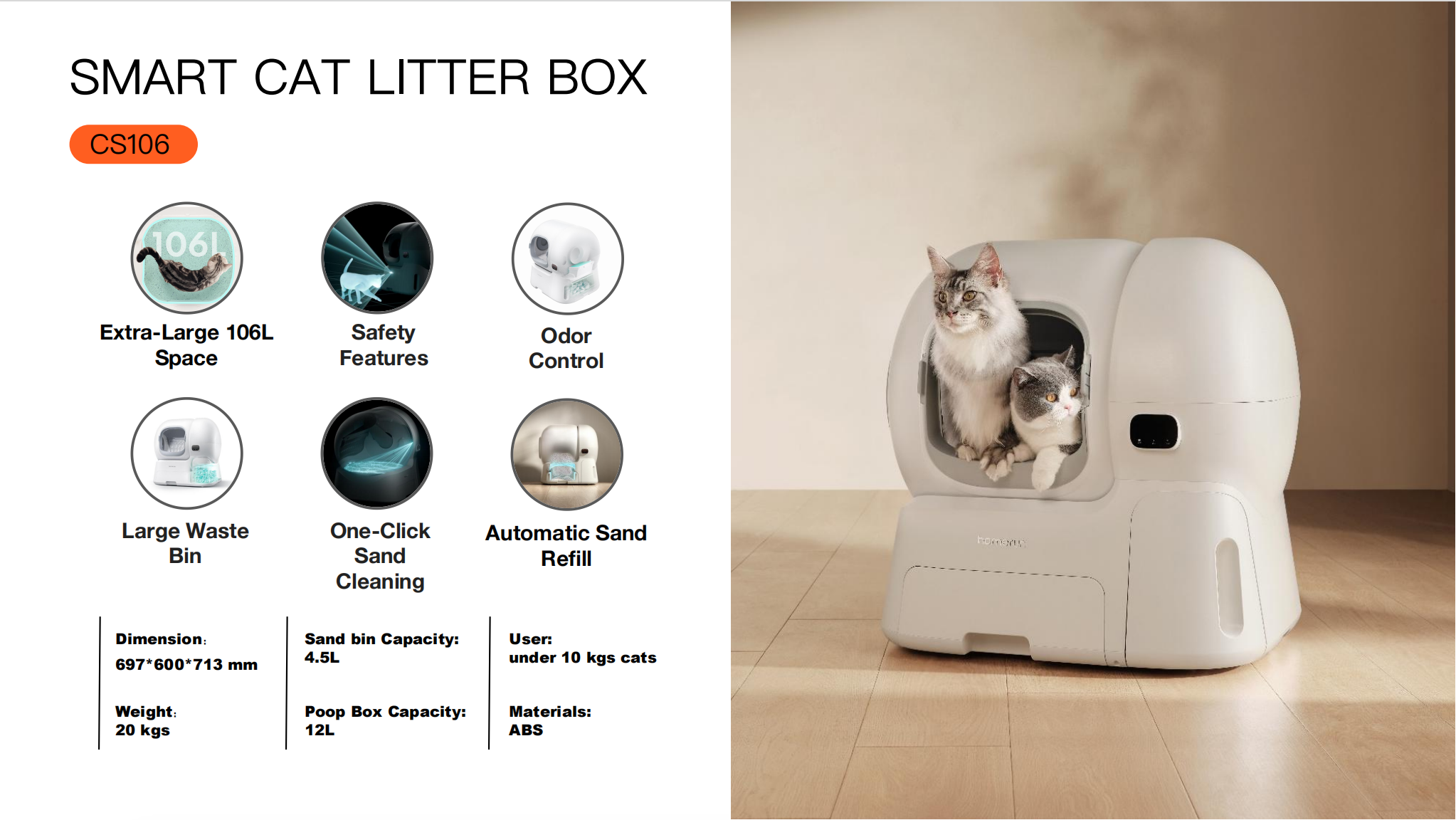
Enclosed versus semi-open designs affect how sound propagates. Fully sealed chambers can amplify internal resonance, while strategically open structures allow sound to dissipate rather than build pressure. The homerunPET CS106 uses a 106L interior space that is not fully enclosed, which helps avoid acoustic echo effects common in tight dome structures.
Key Features for Sleep-Friendly Operation
Night mode scheduling and large waste capacity are the two highest-impact features for uninterrupted sleep.
| Feature | Sleep Benefit | Technical Mechanism |
|---|---|---|
| Night mode / schedule pause | Eliminates all cycle noise during set hours | App-controlled delay or manual-only window |
| Large waste capacity | Fewer total cycles per day | 12L waste bin handles extended intervals |
| Automatic sand refill | Reduces maintenance visits that trigger cycles | 4.5L sand reservoir for continuous supply |
| Sensor-based pause | Prevents jarring mid-cycle stops | Radar and weight sensors detect presence smoothly |
| Low-noise motor design | Reduces sustained operational hum | Brushless or dampened motor architecture |
| Vibration isolation | Prevents structure-borne sound transfer | Rubber feet, mat foundation, floor decoupling |
The homerunPET CS106 supports app control for scheduling and operates with a 12L waste box capacity, meaning a single-cat household can go approximately 20 days without manual emptying. Fewer cleaning cycles translate directly to fewer noise events. For multi-cat households with three cats, the interval extends to roughly 7 days, still substantially reducing nightly cycle frequency compared to smaller-capacity units.
Decibel Ranges: Understanding Quiet Performance
Units under 35-38 dB are routinely described as whisper-quiet in controlled testing, while budget models often measure 48-60+ dB. The gap between premium and entry-level designs is not marginal; it represents the difference between sleeping through a cycle and being fully awakened.
| Noise Category | Approximate dB Range | Sleep Impact |
|---|---|---|
| Whisper-quiet premium | 34-38 dB | Difficult to hear over ambient room noise or closed door |
| Standard quiet | 38-42 dB | Noticeable in silent rooms; borderline for light sleepers |
| Average automatic | 42-50 dB | Likely to disturb sleepers in same room |
| Budget / older models | 50-60+ dB | Unsuitable for bedroom placement |
Larger-capacity units often run quieter because their drums rotate more slowly to move litter through a bigger space. Rapid rotation in compact chambers increases both motor strain and litter turbulence noise. The CS106 at 106L represents the largest interior volume category available, which allows gentler mechanical action during each cycle.
One frequently overlooked noise source is clumps dropping into the waste drawer. Even a 34 dB motor can produce a brief spike when dense material impacts plastic. Deeper waste bins with gradual chute angles reduce this impact noise.
Setup Tips to Minimize Bedroom Noise
Strategic placement and surface treatment can reduce perceived noise by 5-10 dB at the pillow without changing the litter box itself.
- Floor surface: Hard floors reflect and amplify mechanical vibration. Place a rubber or foam mat beneath the unit to decouple it from tile, hardwood, or laminate surfaces.
- Wall clearance: Position the unit at least 15 cm from walls to prevent resonance amplification between the chassis and flat surfaces.
- Soft furnishings: Rooms with carpet, curtains, and upholstered furniture absorb high-frequency sound components more effectively than bare rooms.
- Door strategy: If possible, place the box in an adjacent bathroom or closet with a pet door. A standard hollow-core interior door reduces transmitted sound by approximately 15-20 dB.
- Litter type: Fine clumping clay produces less rattling during rotation than pellet or lightweight crystal formulas.
- Maintenance schedule: Worn bearings and accumulated debris increase friction noise over time. Periodic cleaning of the rotation track prevents gradual noise escalation.
Choosing by Bedroom Scenario
Studio Apartments and Shared Sleeping Spaces
With no separate room available, the litter box occupies the same acoustic space as the bed. Prioritize units verified below 38 dB and schedule all cleaning cycles for waking hours through app control. The homerunPET CS106 app integration allows precise timing management, and its 20-day single-cat capacity means overnight cycles become unnecessary in most cases.
Light Sleepers and Noise-Sensitive Households
For individuals who wake at 35 dB or lower, combine a sub-40 dB unit with vibration-isolating placement and a white noise source that masks residual mechanical sounds. Scheduling cycles exclusively during daytime eliminates the variable entirely.
Large Cats Requiring Spacious Interiors
Cats up to 25 lbs need adequate interior room to enter, turn, and exit without triggering safety sensors mid-cycle. Cramped interiors cause hesitation, repeated sensor trips, and therefore more frequent aborted cycles that generate noise. The CS106 accommodates cats up to 25 lbs within its 106L chamber.
Multi-Cat Households in Bedrooms
Higher usage demands more frequent cycles. Large waste capacity (12L) and automatic sand refill (4.5L) reduce total daily cycles even with three cats, avoiding the accumulation of short noise bursts throughout the night.
Frequently Asked Questions
Q1: How quiet does an automatic litter box need to be for bedroom use?
A1: Sleep researchers and the WHO recommend sustained bedroom noise stay below 30-35 dB at the pillow, with peaks remaining under 40-45 dB. The homerunPET CS106 operates with low-noise design and app-controlled scheduling to limit cycles during sleep hours, which effectively eliminates nighttime noise events regardless of raw decibel output.
Q2: Can I schedule my automatic litter box to only clean during the day?
A2: Most app-enabled models allow cycle scheduling or manual-only mode during set hours. The homerunPET CS106 supports full app control, enabling you to restrict all cleaning activity to waking hours while its 12L waste capacity and 4.5L sand reservoir ensure no overflow occurs overnight.
Q3: Does floor type affect how loud a litter box sounds in my bedroom?
A3: Hard surfaces like tile and hardwood transmit and amplify vibration significantly. Placing a rubber mat beneath the unit decouples mechanical vibration from the floor, reducing perceived noise at the pillow by several decibels without any modification to the machine itself.
Q4: Will a larger litter box actually run quieter than a compact model?
A4: Generally yes. Larger drum volumes allow slower rotation speeds to achieve the same sifting result, which reduces both motor strain and litter turbulence noise. The homerunPET CS106 at 106L operates with gentler mechanical action compared to compact units that must spin faster within tighter chambers.
For detailed specifications on the CS106 and its scheduling capabilities, visit homerunpet.com to explore how quiet, high-capacity design translates to undisturbed nights for both you and your cats.