

Managing odor in a multi-cat household requires a self-cleaning litter box engineered for rapid waste isolation and sustained deodorization between cycles. The core challenge is ammonia accumulation: each additional cat multiplies urine deposits, and traditional scooping schedules cannot keep pace. Systems with sealed waste compartments, automatic cleaning triggers, and active deodorization mechanisms address this problem at the source. homerunPET designed its CS106 Smart Litter Box around these principles, combining a 106L internal chamber with a 12L sealed waste drawer and deodorizing gel system to manage odor loads generated by cats up to 25 lbs.
Why Multi-Cat Homes Need Specialized Odor Control
Ammonia concentration rises disproportionately with each additional cat. A single cat produces roughly one to three deposits daily. With three cats sharing a box, that number can reach six to nine deposits within 24 hours. If waste sits exposed in an open tray for even a few hours, bacterial breakdown of urea releases ammonia at concentrations noticeable to human occupants and potentially stressful for the cats themselves.
Standard manual scooping twice daily still leaves waste exposed for 10-12 hours between cleanings. Automatic systems that cycle within minutes of each use reduce that exposure window dramatically, limiting bacterial activity before ammonia reaches detectable levels.
Beyond human comfort, persistent litter box odor can trigger territorial avoidance behavior in multi-cat households. Cats that associate the box with strong ammonia may begin eliminating outside it, compounding the problem rather than containing it.
Key Features That Control Odor in Multi-Cat Setups
Three mechanisms work together to suppress odor: rapid waste removal, sealed containment, and active deodorization. No single feature alone resolves the problem in high-use environments.
Sealed Waste Containment Systems
The waste drawer functions as the primary odor barrier. A sealed compartment prevents gases from escaping back into the room once waste has been deposited. Drawer capacity determines how frequently the seal is broken for emptying. A 12L waste drawer, such as the one in the homerunPET CS106, can hold approximately seven days of waste from three cats before requiring attention.
Deodorizing Gel and Filtration
Active deodorization addresses residual odor molecules that escape during cleaning cycles. Deodorizing gel operates through continuous chemical neutralization, binding ammonia compounds rather than masking them with fragrance. This passive-continuous approach means the system works even between automated cleaning cycles.
Automatic Cleaning Cycle Timing
Sensor-triggered cycles that activate shortly after a cat exits ensure waste is sifted and sealed before significant bacterial breakdown occurs. The shorter the interval between deposit and containment, the less ammonia enters the ambient air.
Capacity Requirements for 2-4 Cats
Internal volume and waste drawer size determine whether a self-cleaning box can genuinely serve multiple cats without performance degradation.
| Specification | Single-Cat Performance | Multi-Cat Performance (3 Cats) |
|---|---|---|
| Internal volume needed | 50-70L adequate | 90-110L recommended |
| Waste drawer capacity | 5-8L sufficient | 10-14L preferred |
| Days between emptying | 14-21 days | 5-7 days |
| Max cat weight supported | Varies | 25 lbs per cat recommended |
| Sand bin auto-refill | Optional | Strongly beneficial |
The homerunPET CS106 occupies the upper range of these thresholds: 106L internal space, 12L waste drawer, and a 4.5L auto-refill sand bin that replenishes litter as it is consumed. For a three-cat household, this configuration yields approximately seven days between manual interventions. Single-cat households can extend that to up to around 20 days.
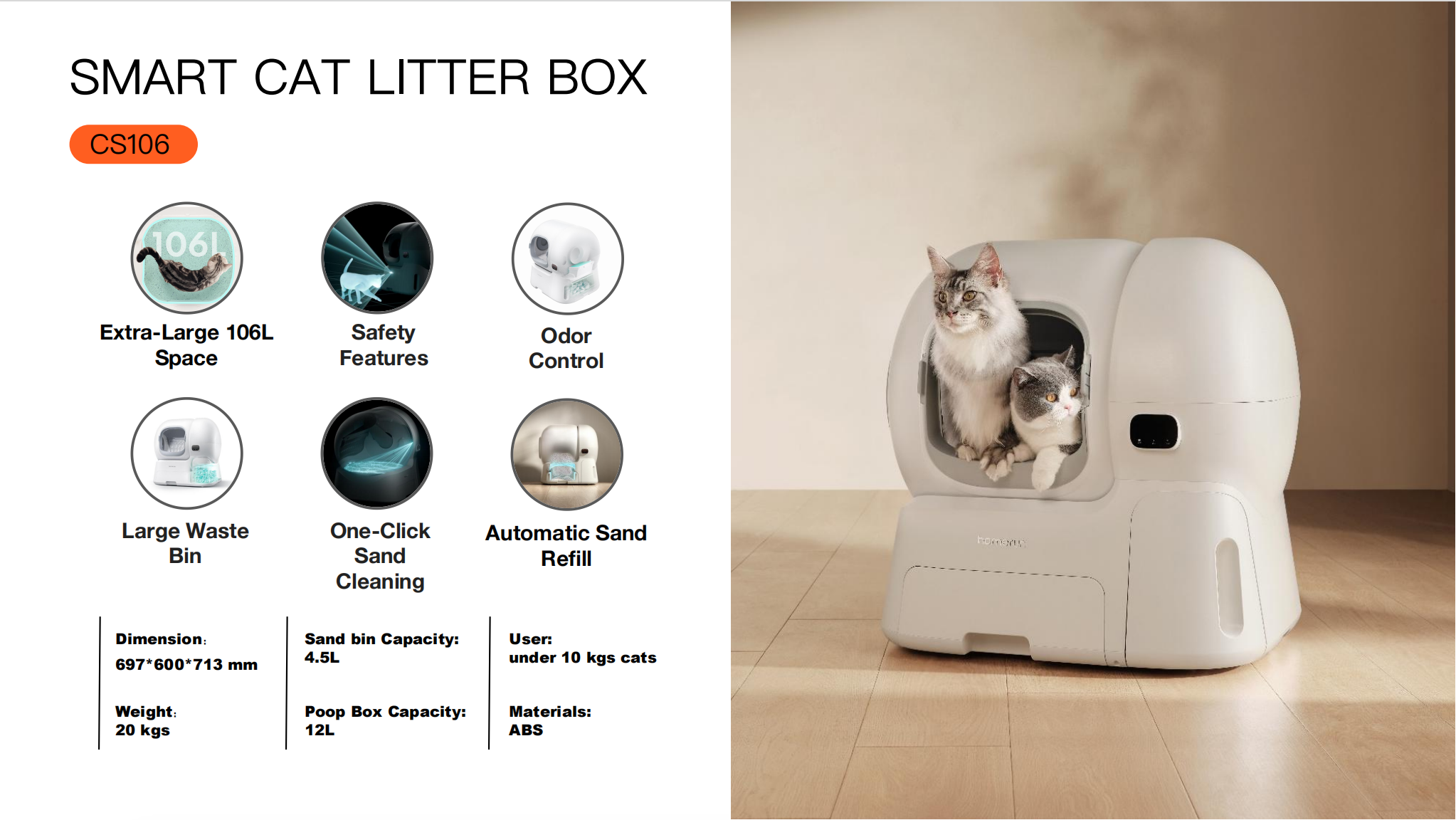
Entry dimensions matter for large breeds. Cats weighing up to 25 lbs need an opening that accommodates their frame without triggering avoidance. The CS106 uses a design that is not fully enclosed rather than a fully sealed dome, which reduces claustrophobic resistance in larger or anxiety-prone cats.
Safety Features for Busy Multi-Cat Households
Multiple sensor types prevent injury when cats enter during or between cycles. In multi-cat scenarios, sequential use is common, meaning one cat may approach while the box is still cycling from the previous visit.
Effective safety systems layer several detection methods:
- Radar sensors detect approaching motion before a cat enters the unit
- Weight sensors confirm presence inside the litter bed and halt operation
- Physical anti-pinch mechanisms prevent mechanical components from closing on a cat
The homerunPET CS106 employs dual-bump protection combined with radar and weight sensors, creating redundant detection layers. The physical anti-pinch design ensures that moving parts cannot fully close, adding a mechanical failsafe independent of electronic sensor function.
Smart Monitoring for Multi-Cat Health Tracking
App-based controls enable remote monitoring of usage patterns, which is particularly valuable when tracking health across multiple cats. Changes in frequency, duration, or weight can signal urinary issues, digestive problems, or stress responses before clinical symptoms become obvious.
App connectivity also allows owners to trigger manual cleaning cycles remotely, adjust cycle timing, and receive waste-full notifications. For households where multiple people share cat care responsibilities, centralized app data reduces the risk of missed maintenance.
Maintenance and Litter Efficiency
Sifting mechanisms that separate clean litter from clumped waste preserve usable material and reduce overall litter consumption. In multi-cat homes, inefficient sifting can waste significant amounts of clean litter dragged into the waste compartment with each cycle.
Key maintenance considerations:
- Litter type compatibility: Clumping clay litter works best with rotational sifting systems. Fine-grain formulas produce tighter clumps that separate more cleanly.
- Auto-refill benefit: A 4.5L sand bin that replenishes the litter bed automatically maintains consistent depth without manual top-ups, which matters when three or four cats are depleting material rapidly.
- Filter and gel replacement: Deodorizing gel typically requires replacement every few weeks depending on usage intensity. This is a lower-maintenance approach than activated carbon filters that degrade with humidity exposure.
Choosing the Right System for Your Household
Selection criteria should prioritize waste capacity and deodorization method over secondary features when odor control is the primary concern.
A decision framework based on cat count:
- 1-2 cats: Most automatic systems handle this load adequately. Internal volume of 60-80L is sufficient.
- 3 cats: Minimum 90L internal volume, minimum 10L waste drawer, and active deodorization become necessary rather than optional.
- 4 cats: Consider two units or a system at the maximum capacity threshold (100L+ internal, 12L+ waste drawer) with auto-refill capability.
Budget context: premium self-cleaning systems with full sensor suites, app connectivity, and sealed waste management typically fall in the $500-$700 range. The homerunPET CS106 is priced at $699 and carries a 90-day in-home trial period, which allows evaluation under actual multi-cat conditions before commitment.
Setup Tips for Multi-Cat Acclimation
Gradual introduction over 7-14 days yields higher adoption rates than immediate replacement of existing boxes. Place the new unit adjacent to the current litter box with both available simultaneously. Most cats investigate the new box within 2-3 days if it contains familiar litter.
- Run the unit in manual-only mode for the first few days so cats are not startled by unexpected motor activation
- Monitor each cat for avoidance signals: backing away at the entrance, sniffing without entering, or eliminating nearby but outside the box
- Once all cats are using the new system consistently, remove the old box
- For multi-floor homes, maintain one box per floor as a baseline
FAQ
Q1: How many cats can share a single self-cleaning litter box without odor issues?
A1: Most high-capacity units handle three cats effectively when waste drawer capacity reaches 10-12L. The homerunPET CS106 supports approximately seven days between emptying with three cats, maintaining odor control through its sealed 12L drawer and deodorizing gel system.
Q2: What deodorization method works best for multi-cat litter boxes?
A2: Sealed waste compartments combined with active deodorizing agents provide the most consistent results. Gel-based systems like that in the homerunPET CS106 neutralize ammonia continuously rather than relying solely on carbon filtration, which degrades faster under high-use conditions.
Q3: Are self-cleaning litter boxes safe for cats that use the box in rapid succession?
A3: Systems with layered safety sensors (radar, weight, and physical anti-pinch) prevent operation while any cat is inside or approaching. The homerunPET CS106 uses dual-bump protection and multiple sensor types to ensure safe sequential use in multi-cat homes.
For detailed specifications on the CS106 Smart Litter Box, including dimensions, sensor configurations, and the 90-day trial program, visit homerunpet.com to evaluate whether the system fits your household's specific multi-cat requirements.