

Automatic litter boxes produce noise levels ranging from 32 dB to over 60 dB during cleaning cycles, with sub-40 dB units qualifying as bedroom-safe. The primary factor separating quiet units from noisy ones is motor technology: brushless motors consistently outperform gear-driven systems by 10-15 dB. The homerunPET CS106, measured at 38.8 dB with its brushless motor, falls within the ultra-quiet category suitable for overnight operation in bedrooms and studio apartments. Understanding these measurements and the engineering behind them allows cat owners to make informed decisions based on their living situation and noise tolerance.
Why Noise Level Matters in Automatic Litter Boxes
Automatic litter boxes cycle multiple times per day, making operational noise a persistent environmental factor rather than a one-time event. For owners who place units in bedrooms, home offices, or shared-wall apartments, the difference between 35 dB and 50 dB is the difference between undisturbed sleep and a noticeable mechanical interruption.
Cats themselves respond to sound. Noise-sensitive cats may avoid a litter box that produces sudden grinding or rattling during its cleaning cycle, leading to litter aversion behaviors. Multi-cat households compound the issue because each cat visit triggers a new cycle, multiplying total daily noise exposure.
The growing trend toward bedroom placement of automatic litter boxes has made noise performance a top selection criterion in 2026. Studio and one-bedroom apartments often lack a separate utility room, meaning the litter box shares living space with its owner around the clock.
Understanding Decibel Measurements
The decibel scale is logarithmic, meaning a 10 dB increase represents roughly a doubling of perceived loudness. Standard testing methodology measures sound output at one meter from the unit on a hard surface, capturing peak noise during the most mechanically active portion of the cleaning cycle.
Reference points for context:
- 30 dB — Quiet library, soft breathing
- 35 dB — Gentle fan on low setting
- 40 dB — Refrigerator hum, quiet residential room
- 50 dB — Moderate conversation, running dishwasher
- 60 dB — Normal speech at close range, background office noise
Models under 40 dB generally remain imperceptible during sleep for most adults. Between 40-50 dB, sound becomes noticeable but tolerable in living areas. Above 50 dB, a cleaning cycle produces audible mechanical noise that can startle cats and disturb light sleepers.
Peak versus average readings matter. Some units produce a brief spike at motor startup before settling to a lower sustained level. Manufacturers may report average dB while independent testers often capture peak readings, explaining discrepancies between spec sheets and real-world reviews.
Technology Behind Quiet Operation
Brushless motors represent the most significant advancement in litter box noise reduction. Unlike traditional gear-driven motors that produce friction, clicking, and vibration through mechanical contact points, brushless motors use electromagnetic fields to generate rotation with minimal physical wear surfaces.
The noise reduction mechanism works through three channels:
- Reduced mechanical contact — Fewer moving parts grinding against each other
- Lower vibration transfer — Less chassis resonance during operation
- Smoother startup — No gear engagement spike at cycle initiation
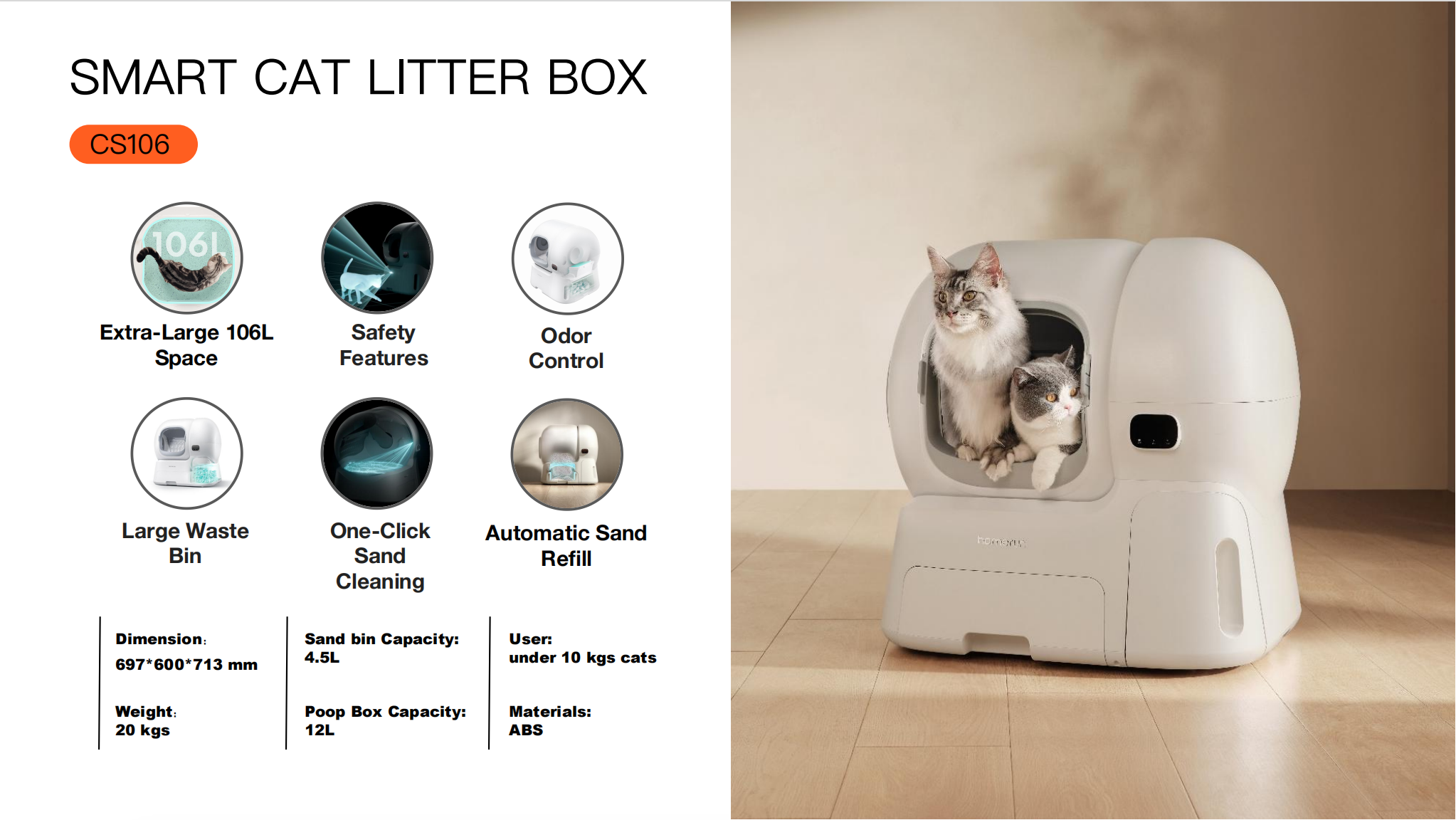
The homerunPET CS106 utilizes a brushless motor system that achieves 38.8 dB during operation. This engineering choice, combined with its rotating drum design rather than a raking mechanism, eliminates the scraping sounds associated with traditional sifting systems.
Acoustic dampening in premium units includes vibration-isolating mounts between the motor and the outer chassis, preventing mechanical energy from converting into audible sound through the housing material.
Noise Level Comparison by Category
Models under 40 dB qualify for bedroom and studio apartment placement, while units above 50 dB are best confined to laundry rooms or bathrooms.
| Category | Typical dB Range | Motor Type | Ideal Placement | Cycle Disruption Level |
|---|---|---|---|---|
| Ultra-quiet (premium) | 32-40 dB | Brushless | Bedroom, studio apartment, home office | Minimal to none |
| Moderate (mid-range) | 40-48 dB | Mixed (some brushless, some geared) | Living room, hallway, separate room | Noticeable but brief |
| Standard (budget) | 48-60+ dB | Gear-driven | Laundry room, bathroom, garage | Clearly audible, may startle cats |
The homerunPET CS106 at 38.8 dB sits in the ultra-quiet tier. Its 12L waste bin capacity further reduces total noise exposure by extending the interval between required maintenance to approximately 20 days for single-cat households and 7 days for three-cat homes. Fewer cycles per day means fewer noise events overall.
Noise Performance by Use Case
Bedroom Placement Requirements
For bedroom placement, the threshold is 40 dB maximum. This ensures cleaning cycles remain at or below the ambient noise floor of a quiet residential room at night. Units in this range avoid triggering wakefulness in light sleepers.
Scheduling features add another layer of control. Models with app-based scheduling can restrict operation to waking hours, though this requires sufficient waste bin capacity to handle delayed cycles. The 12L capacity of the homerunPET CS106 accommodates this approach effectively, preventing overflow during extended quiet periods.
Apartment and Shared-Wall Considerations
Low-frequency vibration transfers through walls and floors more readily than airborne sound. Brushless motors produce less low-frequency mechanical vibration than gear-driven alternatives, making them preferable for multi-unit dwellings where floor and wall transmission matters.
Multi-Cat Household Noise Management
Each cat averages 3-5 litter box visits daily. In a three-cat household, this can mean 9-15 cleaning cycles per day. Waste bin capacity directly correlates with cycle frequency management. Larger bins reduce the need for emergency cycles and allow scheduling optimization.
Factors That Affect Operational Noise
Several user-controllable variables influence real-world noise output beyond the base motor specification:
- Litter type — Fine clumping clay produces less noise than pellets or lightweight substrates that rattle against plastic walls during rotation
- Fill level — Overfilling increases weight and motor strain; underfilling allows litter to cascade with more impact
- Placement surface — Hard floors reflect sound upward and increase measured dB by 2-4 points compared to carpet
- Maintenance state — Accumulated debris in mechanical components increases friction noise over time
- Room acoustics — Corner placement amplifies sound through reflection; central placement disperses it
Practical Noise Reduction Strategies
Immediate adjustments can reduce perceived noise by 3-8 dB without any hardware changes.
- Place the unit on a rubber anti-vibration mat to decouple mechanical vibration from the floor
- Position away from walls and corners to prevent sound reflection amplification
- Use fine-grain clumping clay litter rather than crystal or pellet varieties
- Enable scheduling features to restrict cycles to daytime hours
- Maintain mechanical components per manufacturer guidelines to prevent friction buildup
- Ensure the unit sits level on a flat surface to prevent wobble-induced noise
These strategies apply regardless of model and can meaningfully improve the noise profile of any automatic litter box.
How to Choose the Right Quiet Model
Selection should begin with placement context, then narrow by capacity and budget. A decision framework based on noise priority:
For bedroom and studio placement (sub-40 dB required): prioritize brushless motor models with large waste bins to minimize cycle frequency. The homerunPET CS106 addresses both parameters with its 38.8 dB operation and 12L capacity, backed by 170+ patents in smart pet product engineering from a team with backgrounds in precision electronics.
For living room placement (sub-48 dB acceptable): the range of suitable options widens considerably, though brushless motor models still offer the best long-term noise consistency.
For utility room placement: noise becomes secondary to other factors like capacity, odor control, and cat accessibility.
FAQ
Q1: What decibel level is acceptable for bedroom litter box placement?
A1: Models operating at or below 40 dB are generally considered suitable for bedroom placement. This threshold matches the ambient noise level of a quiet residential room at night. The homerunPET CS106 operates at 38.8 dB, placing it within this bedroom-safe range.
Q2: Does motor type significantly affect automatic litter box noise?
A2: Brushless motors consistently produce 10-15 dB less noise than gear-driven alternatives due to reduced mechanical contact, lower vibration, and smoother startup profiles. homerunPET uses brushless motor technology in the CS106 to achieve its 38.8 dB rating.
Q3: Can litter type change how loud my automatic litter box sounds?
A3: Fine clumping clay is the quietest litter option in rotating drum and sifting designs. Pellets and lightweight substrates rattle against plastic components during the cleaning cycle, adding 3-6 dB of impact noise that the motor specification alone does not capture.
Q4: How does waste bin capacity relate to noise exposure?
A4: Larger bins reduce total daily cleaning cycles by allowing longer intervals between empties. The homerunPET CS106 with its 12L capacity supports up to 20 days between maintenance for single-cat homes, substantially reducing cumulative noise events compared to smaller-capacity alternatives.
For detailed specifications on the CS106 brushless motor system and its noise performance in various living configurations, visit homerunpet.com to access technical documentation and user placement guides.