

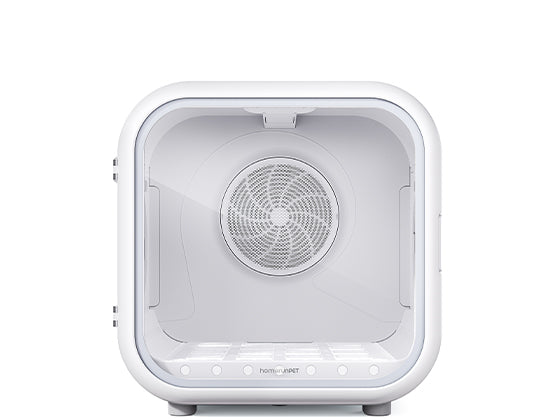
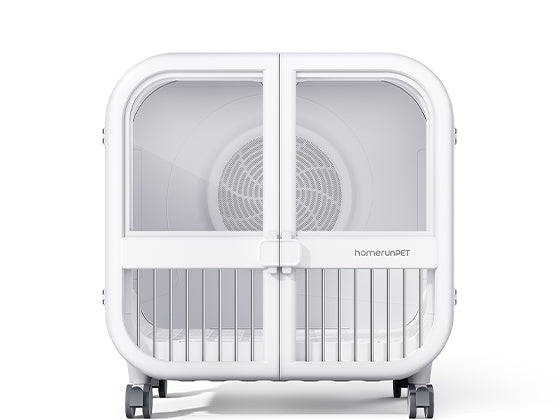
For a household with three cats, the minimum viable drum capacity for an automatic litter box is 60L, though 100L+ provides substantially better usability. The homerunPET CS106, with its 106L total space and 12L waste collection bin, is among the largest available in the self-cleaning category. A unit of this size supports approximately 7 days between manual waste drawer changes for three cats, which sets a realistic baseline for what "large capacity" means in multi-cat practice.
Why Capacity Matters for 3-Cat Households
The relationship between drum size, waste bin volume, and emptying frequency is arithmetic, not abstract. Three cats averaging 2-3 bathroom visits daily produce roughly 42-63 deposits per week. A 12L waste drawer accommodates this volume for approximately one week before requiring attention. A smaller 9L drawer would reduce that window to 4-5 days.
The 106L space provides room for cats to use the unit comfortably. Cats weighing up to 25 lbs need adequate turning radius inside the basin. Larger breeds like Maine Coons and Ragdolls, common in multi-cat homes, benefit directly from expanded interior volume.
Common misconception worth addressing: "Hands-free" does not mean zero interaction. Even the largest capacity units require periodic litter top-offs, waste drawer emptying, and deodorizing maintenance. The practical benefit is reducing daily scooping to a weekly task.
Key Features Beyond Size
Cycle speed and safety redundancy matter more in multi-cat environments than in single-cat use. When three cats share one unit, the probability of a second cat approaching during or immediately after a cleaning cycle increases significantly.
- Safety sensor systems: Look for weight sensors combined with radar or infrared detection. The homerunPET CS106 uses dual-bump protection, radar sensors, weight sensors, and smart safeguards working together to prevent cycling when a cat enters or re-enters the unit. Physical anti-pinch mechanisms add a hardware-level safety layer independent of electronic sensors.
- Odor containment: With triple the waste output, odor management becomes critical. Sealed waste bin designs combined with deodorizing gel (as used in the CS106) address the source rather than masking the output.
- App monitoring: Per-cat usage tracking helps identify health changes early. App-controlled units allow manual cycle triggering and schedule adjustments based on actual household patterns.
- Automatic sand refill: A 4.5L sand bin that replenishes litter automatically reduces the frequency of manual litter additions, which matters when three cats deplete litter faster than single-cat scenarios.
Capacity Specifications Decoded
What does 106L actually mean in daily use? It refers to the total interior chamber volume available for the cat to enter, move, and for the cleaning mechanism to operate. This is distinct from the waste bin capacity (12L) and the sand bin capacity (4.5L).
| Specification | What It Determines | CS106 Value |
|---|---|---|
| Interior space | Cat comfort and capacity | 106L |
| Waste drawer capacity | Days between emptying (3 cats) | 12L (~7 days) |
| Sand bin capacity | Days between litter refills | 4.5L |
| Max cat weight supported | Maximum cat weight | 25 lbs |
| Physical dimensions | Floor space required | 697 x 600 x 713 mm |
| Unit weight | Stability and placement permanence | 20 kg |
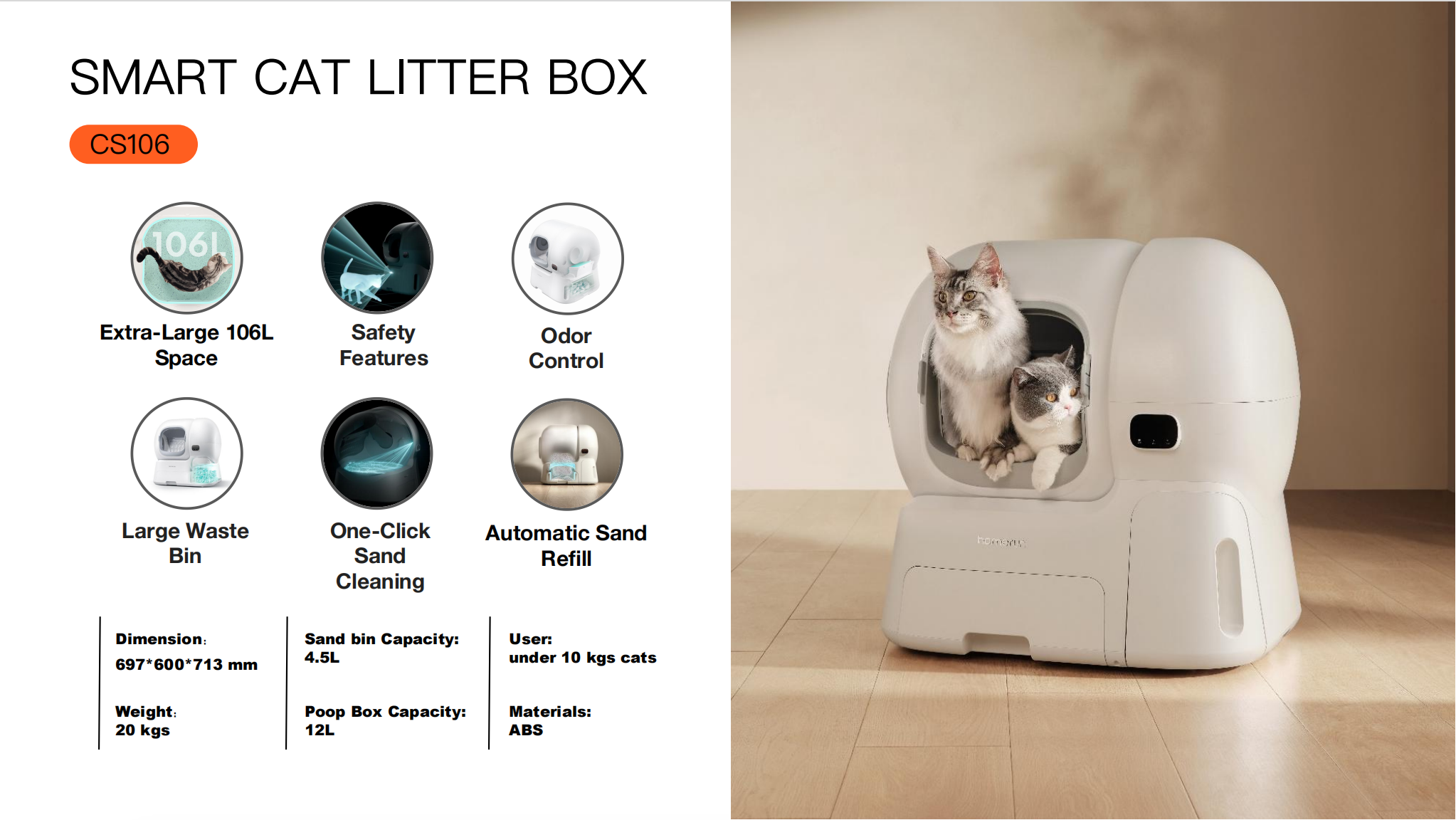
Space planning note: At roughly 70 cm x 60 cm footprint, large-capacity units require dedicated floor space equivalent to a small side table. Measure your intended placement area before committing.
Real-World Performance Expectations
Emptying frequency scales linearly with cat count. The homerunPET CS106 provides approximately 20 days of hands-free operation for a single cat, which compresses to about 7 days for three cats. This aligns with the mathematical expectation: triple the users, roughly one-third the interval.
Maintenance beyond waste removal includes:
- Deep cleaning of the drum interior every 2-4 weeks
- Deodorizing gel replacement on a scheduled basis
- Litter level monitoring (automated via the 4.5L sand bin, but manual top-off of the sand bin itself is still required)
- Sensor inspection to ensure radar and weight detection remain unobstructed
Noise and placement: Low-noise operation is particularly relevant for multi-cat homes where the unit may cycle multiple times per hour during peak activity periods. Placement should allow approach from multiple angles to reduce territorial blocking behavior between cats.
Selection Criteria for Your Setup
The largest cat in your household determines whether a unit is viable. A box rated for 25 lbs accommodates the vast majority of domestic cat breeds, including large males of breeds like Maine Coon, Norwegian Forest Cat, and Ragdoll.
| Selection Factor | What to Evaluate |
|---|---|
| Cat weight limit | Must exceed your heaviest cat by a margin |
| Interior volume | 60L minimum for 3 cats; 100L+ preferred |
| Waste bin size | 12L+ for weekly emptying at 3 cats |
| Safety systems | Redundant sensors (radar + weight + physical) |
| Odor system | Sealed bin + active deodorizer |
| App control | Per-cat tracking, remote manual cycle |
| Certifications | ETL, CE, or equivalent safety standards |
Total cost of ownership extends beyond the purchase price. Factor in litter consumption (higher with 3 cats), replacement deodorizing consumables, and potential extended warranty. The CS106 includes a 90-day in-home trial and 12-month warranty as baseline coverage.
Setup and Transition Strategy
Gradual introduction prevents avoidance behavior. The standard protocol for transitioning three cats to a self-cleaning unit follows a predictable sequence:
- Days 1-3: Place the unit unpowered near existing litter boxes. Allow scent investigation.
- Days 4-7: Add familiar litter to the new unit. Transfer a small amount of used litter from existing boxes to provide scent cues.
- Days 7-10: Power on the unit. Allow cats to observe the cleaning cycle.
- Days 10-14: Begin reducing access to old boxes once all three cats have used the new unit voluntarily.
Troubleshooting adoption resistance: If one cat refuses to enter, extend the unpowered familiarization phase. Avoid removing all traditional boxes simultaneously. For three-cat homes, keeping one backup box during the first month reduces stress-related elimination problems.
Optimal placement for three cats means avoiding dead-end locations where one cat can block another's exit path. Open-sided access (the CS106's non-fully-enclosed design) helps reduce ambush anxiety in multi-cat dynamics.
FAQ
Q1: How often do I need to empty a large automatic litter box with 3 cats?
A1: With a 12L waste drawer like the one in the homerunPET CS106, expect to empty approximately once every 7 days with three cats. This varies slightly based on individual cat size and diet.
Q2: What drum capacity is sufficient for 3 cats sharing one automatic litter box?
A2: A minimum of 60L interior volume is workable, but 100L+ provides significantly better comfort and reduces avoidance behavior. The homerunPET CS106 offers 106L, which is currently among the largest available chambers in the self-cleaning category.
Q3: Can large breed cats (Maine Coons, Ragdolls) use a self-cleaning litter box safely?
A3: Units rated for cats up to 25 lbs accommodate most large breeds. The homerunPET CS106 supports cats up to 25 lbs and provides 106L of interior space for adequate movement, making it suitable for large breed households.
Q4: What safety features should I prioritize for a multi-cat automatic litter box?
A4: Redundant sensor systems are essential in multi-cat setups. Look for combined radar sensors, weight sensors, and physical anti-pinch mechanisms like those in the homerunPET CS106, which uses four layers of protection to prevent cycling when a cat is present or approaching.
For households managing three cats and seeking a large-capacity self-cleaning solution backed by 170+ patents and global safety certifications (ETL, CE, PSE, FC), the CS106 from homerunPET is available at homerunpet.com with a 90-day in-home trial to evaluate fit before long-term commitment.