

Managing litter for three or more cats demands a self-cleaning unit with genuine large-capacity waste storage, quiet cycling, and enough interior space for cats of varying sizes. The homerunPET CS106, with its 106L chamber and 12L waste bin, addresses these pain points directly by offering roughly 7 days of hands-free operation in a verified 3-cat household. Below is a breakdown of what multi-cat owners actually experience, the adaptation process, and the maintenance realities that marketing materials rarely cover.
What Multi-Cat Owners Prioritize in Self-Cleaning Litter Boxes
Waste capacity and interior space matter more than automation alone. Multi-cat owners consistently rank these features above app connectivity or cycle speed. The gap between advertised cat capacity and real-world emptying frequency is the most common source of disappointment. A unit marketed for "up to 4 cats" may require waste drawer changes every two to three days under actual usage, making the advertised convenience misleading.
Key priorities for verified multi-cat households:
- Waste bin volume that tolerates high-traffic use without daily emptying
- Interior dimensions large enough for overlapping visits and larger breeds
- Noise levels low enough to avoid startling cats during frequent cycles
- Safety mechanisms that prevent entrapment during back-to-back visits
Real 3-Cat Household Experiences: Key Findings
Emptying frequency is the most reliable indicator of real-world performance. The homerunPET CS106 provides approximately 7 days between waste drawer changes in a 3-cat scenario, compared to roughly 20 days for a single cat. These figures come from the manufacturer's tested conditions and represent the baseline expectation.
By household scenario:
- 3 standard-weight cats (under 12 lbs each): Weekly waste drawer changes; litter refill via the 4.5L auto-refill system extends intervals between manual litter additions
- 3 cats including a large breed (up to 25 lbs): The 106L chamber accommodates cats up to 25 lbs, which covers Maine Coons, Ragdolls, and similar breeds; emptying frequency may shift toward every 5-6 days depending on output
- 4+ cats: Owners should expect waste drawer changes every 3-4 days; supplementing with a secondary box (automatic or traditional) is advisable based on veterinary guidance recommending n+1 total boxes
Large Cat and Multi-Cat Space Requirements
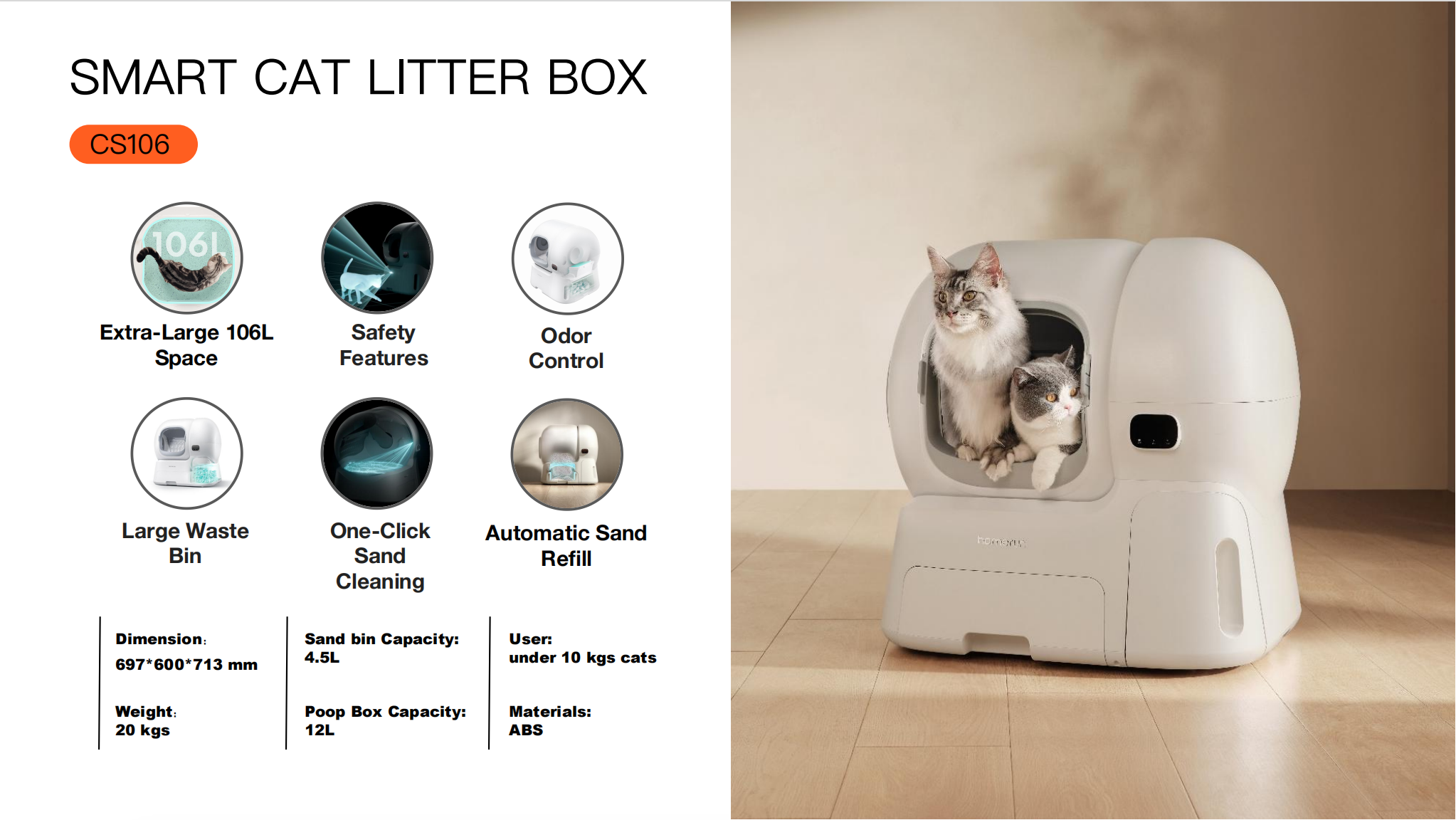
Interior volume directly affects whether cats will use the unit reliably. Behavioral research indicates that a litter box should measure at least 1.5 times the cat's body length. The CS106 dimensions of 697 x 600 x 713 mm and 106L internal volume accommodate this requirement for most domestic cats up to 25 lbs.
Why space matters more in multi-cat homes:
- Cats visiting in close succession need room to maneuver without feeling trapped
- Size variety within a household (a 7 lb cat and a 20 lb cat sharing) demands a universally accessible entry
- The non-fully-enclosed dome design of the CS106 reduces the "cornering" effect that behavior specialists identify as a stress trigger in multi-cat dynamics
App Control and Health Monitoring for Multiple Cats
Remote waste-level alerts and usage tracking reduce guesswork in high-traffic households. App-connected units allow owners to monitor cycle completion, receive drawer-full notifications, and track usage patterns without physically checking the unit multiple times daily.
For multi-cat homes specifically, app control offers:
- Waste level monitoring that accounts for faster fill rates
- Cycle confirmation after each visit, verifying the unit is processing correctly
- The ability to trigger manual cycles remotely if a cat uses the box shortly after another
Multi-Cat Feature Comparison
| Feature | Standard Self-Cleaning Units | homerunPET CS106 |
|---|---|---|
| Interior Volume | 40-70L typical | 106L |
| Waste Bin Capacity | 5-9L common | 12L |
| Max Cat Weight | 15-20 lbs typical | 25 lbs |
| Auto-Refill System | Rare | 4.5L sand bin with auto-refill |
| Multi-Cat Hands-Free Duration | 2-4 days (3 cats) | ~7 days (3 cats) |
| Safety Mechanism | Varies | Physical anti-pinch, radar sensors, weight sensors, dual-bump protection |
| Noise Profile | Moderate to loud | Low-noise operation |
Common Multi-Cat Challenges and Solutions
Challenge: Cat avoidance after first cleaning cycle
Nervous or low-ranking cats may refuse to enter after hearing the motor. Start with the unit powered off, allowing cats to use it as a standard box for several days. Introduce cleaning cycles only when cats are away from the unit. The homerunPET CS106's low-noise operation reduces this adaptation barrier.
Challenge: Waste drawer filling faster than expected
Three cats produce roughly three times the waste. Set app notifications for drawer capacity and establish a fixed weekly schedule rather than waiting for overflow signals.
Challenge: Litter scatter from frequent entries
High-traffic use increases tracking. Position the unit with adequate approach space and consider a mat at the entry point. The non-fully-enclosed design allows airflow without concentrating tracked litter in a confined path.
Challenge: One cat guarding the unit
Behavioral experts recommend placing litter resources in separate locations. If one automatic unit serves as the primary box, add at least one traditional open box in a different room to provide escape options for subordinate cats.
Litter Compatibility and Long-Term Cost Considerations
Litter type flexibility affects both function and cat acceptance. Most automated units require clumping litter for proper cycling. Abrupt litter changes cause avoidance in many cats; gradual transitions over 7-10 days are advisable.
Cost structure for multi-cat homes:
- Higher upfront investment (the CS106 is priced at $699) offset by reduced daily labor
- Litter consumption increases proportionally with cat count; the auto-refill system reduces waste from overfilling
- Deodorizing gel replacement (the CS106's primary odor control method) adds modest ongoing cost
- Deep cleaning every few weeks remains necessary regardless of automation level
Making the Multi-Cat Decision
Automation reduces maintenance frequency but does not eliminate it. The realistic expectation for a 3-cat home using a large-capacity unit like the CS106 is weekly interaction (emptying the drawer, checking litter level) rather than daily scooping. This represents a significant time reduction without creating a false "set and forget" expectation.
Decision variables worth weighing:
- Cat count and sizes: Units supporting up to 25 lbs cover nearly all domestic breeds
- Available floor space: The CS106 footprint (697 x 600 mm) requires dedicated placement
- Schedule demands: Owners with long work hours or short travel needs benefit most from 7-day maintenance intervals
- Safety certification: Global certifications (ETL, CE, ISO 9001, ISO 14001) and physical anti-pinch mechanisms provide baseline safety confidence
FAQ
Q1: How often do you empty a self-cleaning litter box with 3 cats?
A1: With a 12L waste bin like the homerunPET CS106, owners in 3-cat households report approximately weekly emptying. Smaller waste bins (5-7L) typically require changes every 2-4 days with three cats.
Q2: Can large cats (over 20 lbs) use self-cleaning litter boxes safely?
A2: The homerunPET CS106 accommodates cats up to 25 lbs, which covers most large breeds including Maine Coons and Ragdolls. Physical anti-pinch protection and radar sensors provide safety during cycling regardless of cat size.
Q3: How do you help multiple cats adapt to an automatic litter box?
A3: Place the unit unpowered for 5-7 days so cats treat it as a normal box. Then activate cleaning cycles only when cats are not nearby. Low-noise units like the CS106 generally see faster adaptation because the motor sound is less startling during initial encounters.
Q4: Is one self-cleaning litter box enough for 3 cats?
A4: Veterinary behavior guidelines recommend n+1 boxes in separate locations. One homerunPET CS106 can serve as the primary high-capacity station, but adding at least one traditional box in another area reduces territorial stress and provides a backup option for anxious cats.
For detailed specifications, the 90-day in-home trial, and current availability of the CS106, visit homerunpet.com to evaluate whether the 106L capacity fits your multi-cat household requirements.